

Have you ever stood in the middle of your house, looked around, and thought, “I don’t even know where to start?”
I’ve been there more times than I can count.
The dishes are stacked in the sink. Laundry is overflowing from the baskets. Toys have somehow migrated into every room. There are shoes by the front door, random cups on every surface, and every space seems to need your attention at the exact same time.
When you need to figure out how to clean your house when overwhelmed, even deciding where to begin can make your brain freeze.
When my house reached that point, I used to make the same mistake every time.
I would start picking up a few things in the living room and then carry a toy back to one of the kids’ bedrooms. Once I got there, I would notice the bed was not made, so I would start making it. Then I would see dirty clothes on the floor and decide to grab the laundry.
On my way to the laundry room, I would notice the bathroom needed cleaning.
Before I knew it, I had started five different jobs without finishing a single one.
By the end of the day, I was exhausted, but my house somehow still looked messy.
It was not because I was not working hard.
I was simply moving in too many directions at once.
Everything changed when I stopped trying to clean the entire house all at the same time and started following one simple path.
Instead of bouncing from room to room, I began at the back of my house and worked my way forward. I stopped fully organizing items the moment I found them and focused on finishing one room before moving into another.
That one change helped me waste less time, make fewer decisions, and finally see completed spaces.
This is not about cleaning perfectly.
It is about creating enough momentum that your home starts working with you instead of against you.

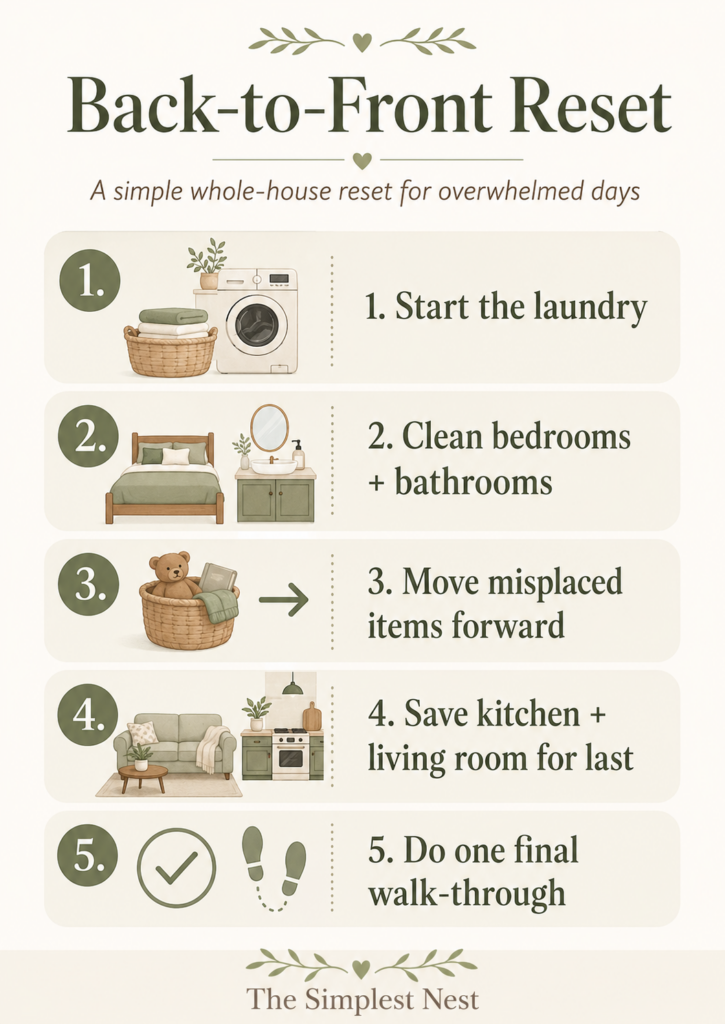
My Back-to-Front Reset at a Glance
When I need to clean my house but feel overwhelmed, this is the basic order I follow:
- Start or switch the laundry.
- Begin with the bedrooms and bathrooms.
- Move misplaced items toward the rooms where they belong.
- Save the kitchen, dining area, and living room for last.
- Finish with one quick walk-through.
You do not have to complete every step perfectly.
The purpose of this method is to give you a clear place to begin and a simple direction to follow.
Why It Is Hard to Clean Your House When You Feel Overwhelmed
If you have ever felt like you have been cleaning all day but your house still looks messy, you are not alone.
For a long time, I thought I needed to try harder or become more productive.
Eventually, I realized that the problem was not a lack of effort. The problem was that I was constantly switching between tasks before finishing any of them.
Motherhood comes with an invisible mental load that many of us carry without even realizing it.
That invisible list can make simple household tasks feel heavy. I talk more about this in my post about the mental load of motherhood and why moms can feel overwhelmed even after working all day.
While you are picking up toys, you are also remembering that the laundry needs to be switched.
You are thinking about what to make for dinner.
You notice that the dishwasher needs to be emptied, the bathroom is running low on toilet paper, and someone needs clean clothes for tomorrow.
Your brain is not focused on one job.
It is trying to manage twenty.
That constant decision-making is exhausting. Cleveland Clinic also offers a helpful explanation of mental load and the pressure of carrying invisible responsibilities.
Then there is the back-and-forth.
I would carry one toy to Penelope’s room, walk inside, and notice laundry on the floor. I would start picking up the clothes and then realize her dresser needed organizing.
Before I knew it, I had completely forgotten why I walked into her room in the first place.
On my way to the laundry room, I would notice that the bathroom sink needed to be wiped down. Then I would remember that I wanted to start a load of towels.
The next thing I knew, I was standing in the kitchen wondering why I was holding a bottle of bathroom cleaner.
Sound familiar?
By the end of the day, I felt busy the entire time, but I had not actually finished a single room.
I was not making progress because I kept interrupting myself.
I think this is something so many moms struggle with. We see everything that needs to be done at once, so we try to do everything at once.
Instead of feeling accomplished, we end up feeling scattered, overwhelmed, and discouraged.
That is why I stopped cleaning wherever my eyes happened to land next.
I gave myself a simple path to follow.
Not because I am naturally organized, but because I needed a system that worked with my brain instead of against it.
How to Clean Your House When Overwhelmed With a Back-to-Front Reset
When my whole house feels overwhelming, I do not start with the room that looks the worst.
I also do not start with the kitchen or living room, even though those are usually the first spaces I notice.
Instead, I begin at the back of the house and slowly work my way forward.
In our home, that means starting with the laundry, bedrooms, and bathrooms before moving toward the kitchen, dining area, and living room.
I started doing it this way because the rooms at the back of our house usually stay clean longer.
Once I finish a bedroom or bathroom, my family is less likely to immediately undo everything I just did.
The kitchen and living room are different.
Someone is always eating, playing, walking through, setting something down, or pulling something back out.
When I cleaned those busy areas first, they would start getting messy again before I ever reached the rest of the house.
Then I felt like I needed to clean them again.
I would end up going in circles—straightening the living room, moving into the kitchen, noticing that the living room was messy again, and returning to where I started.
Meanwhile, the bedrooms and bathrooms still had not been touched.
Starting at the back gives me a clear direction.
I am not constantly asking myself which room I should clean next or following whichever mess catches my eye.
I already know where I am going.
I finish one area, move forward to the next, and keep building momentum until I reach the front of the house.
Step 1: Start the Laundry First
Before I clean any room, I check the laundry.
I either start a new load, move a finished load from the washer to the dryer, or fold anything that is already dry and waiting for me.
I do this first because the laundry can keep moving while I work on everything else.
The washing machine can run while I clean my bedroom.
The dryer can run while I work through the kids’ rooms or bathrooms.
Instead of waiting until the end of the day to remember the laundry, I let it work in the background while I move through the house.
It also gives me an easy first win.
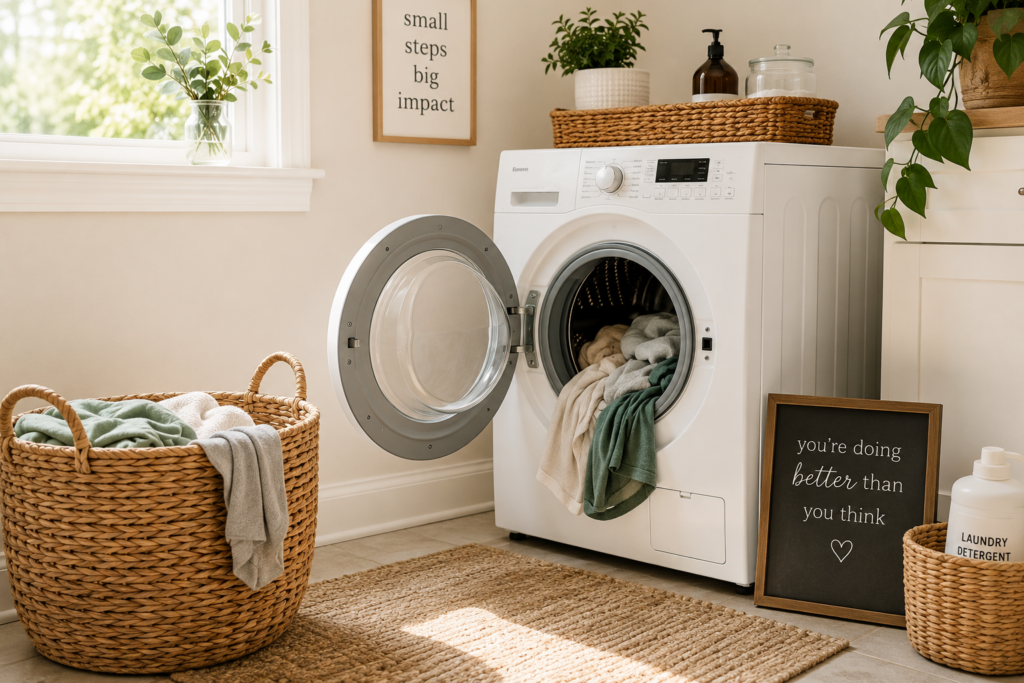
Sometimes, when the entire house feels like too much, even pressing the start button on the washing machine helps me feel like I have begun.
I do not need to solve every pile of laundry before moving on.
I only need to get the process going.
Starting the laundry and following one clear path turns one overwhelming house into a series of smaller, more manageable spaces.
Step 2: Begin With Bedrooms and Bathrooms
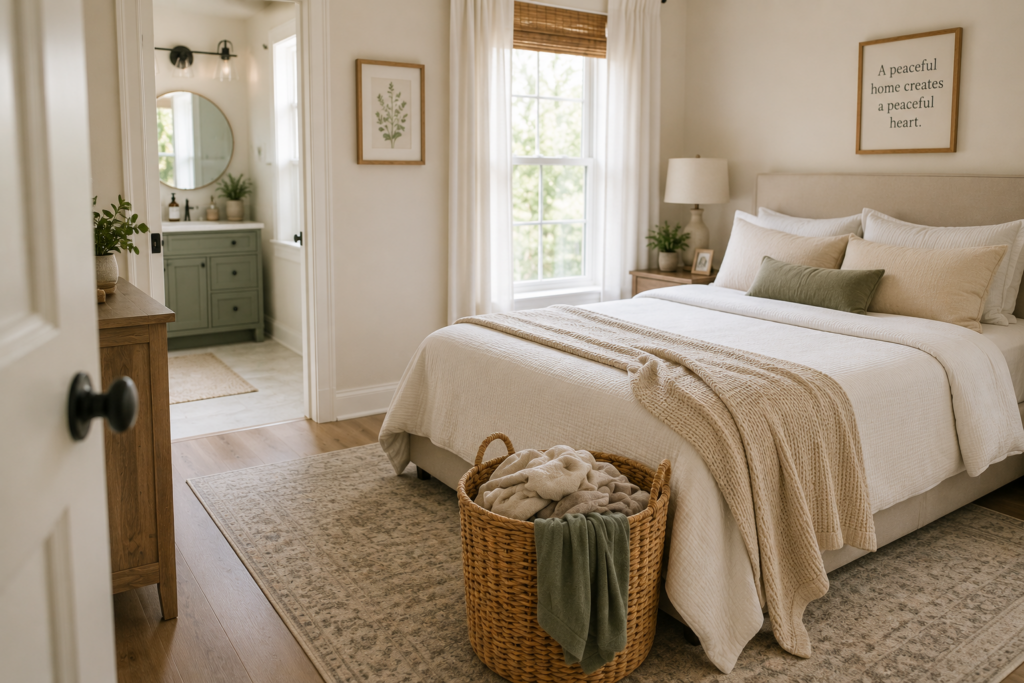
After the laundry is moving, I begin with my bedroom and then work through the kids’ rooms and bathrooms.
These spaces are usually quieter and less likely to become messy again immediately.
Finishing them first gives me a visible sign of progress.
A made bed, a clear floor, and a wiped-down bathroom counter may sound small, but seeing one complete room makes the rest of the house feel less impossible.
I am no longer looking at one enormous cleaning project.
I am looking at the next room in front of me.
My “Throw It Forward” Rule
The biggest thing that keeps me from getting distracted is what I call my “throw it forward” rule.
When I am cleaning one room, I do not stop to organize everything that belongs somewhere else.
I only move it closer to where it belongs.
For example, if I am cleaning my bedroom and find one of Penelope’s toys, I do not carry it into her room, sort through her toy bins, and start putting everything away.
I simply place it in her room and go right back to finishing mine.
If I find Henry’s clothes, I place them in his room.
If something belongs in the bathroom, I set it on the bathroom counter.
If I find dishes or cups, I carry them to the kitchen sink.
If I find laundry, I take it to the laundry room.
That is it.
I am not organizing it yet.
I am not putting every item into its exact spot.
I am only moving it closer to its home.
This helps me remain focused on the room I am already cleaning.
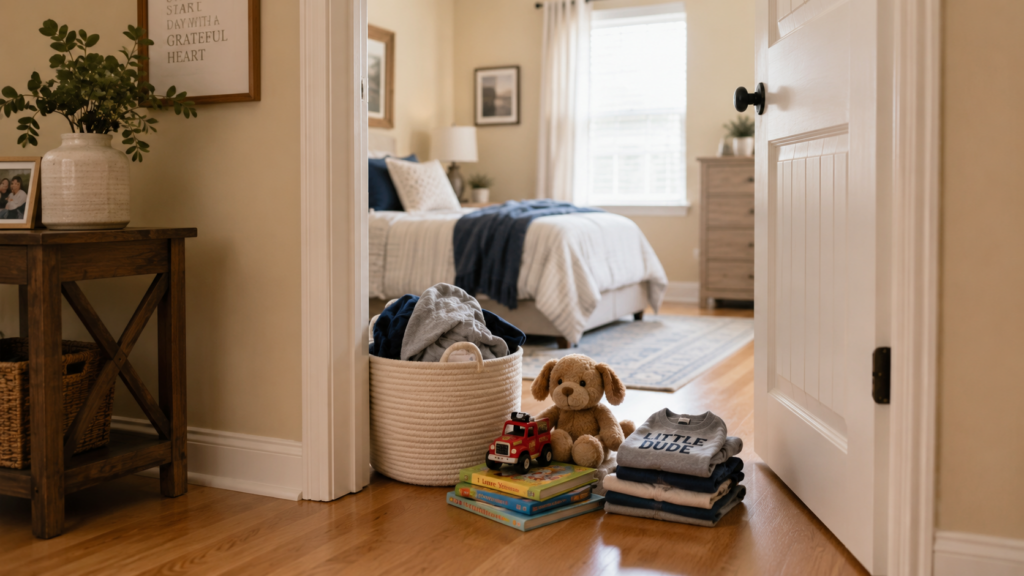
The goal is to finish one space before I allow myself to be pulled into another one.
Later, when I reach Penelope’s room, Henry’s room, the bathroom, or the kitchen, those items will already be waiting for me. I can put them away while I am cleaning that room.
It may look slightly messier for a few minutes because I am creating small piles in the rooms ahead of me, but it saves so much time.
Instead of walking back and forth across the house all day, I keep moving in one clear direction.
I finish the room I am in.
Then I move forward.
That simple rule helps me avoid unnecessary backtracking and actually see progress instead of feeling like I am cleaning in circles.
Why I Don’t Put Everything Away Immediately
At first, it may feel strange to move something into the room where it belongs without putting it in its exact place.
But this is what keeps the reset moving.
If I stop every two minutes to fully organize another room, I never finish the room I started in.
I might carry a toy into Penelope’s room and decide to place it in the correct bin. Then I notice more toys on the floor, clothes that need to be folded, or something on her dresser that needs attention.
Before I know it, I am cleaning her room instead of finishing mine.
The same thing happens when I carry something into Henry’s room, the bathroom, or the kitchen.
I keep chasing small messes around the house without completing one full space.
That is what makes cleaning feel so frustrating.
You are moving constantly, but you never get the satisfaction of seeing a finished room.
By simply placing items closer to where they belong, I eliminate unnecessary backtracking.
I am not walking from one end of the house to the other every time I find one misplaced item.
I am also making fewer decisions.
I do not have to stop and determine the exact home of every toy, shirt, cup, or bathroom item while I am trying to focus on something else.
I only have one decision to make:
Which room does this belong in?
Then I place it there and keep going.
This method cuts down on wasted walking, decision fatigue, and unfinished rooms.
It helps me stay focused long enough to complete one space before moving on to the next.
Once I can see one clean room, the rest of the house starts to feel much more manageable.
Step 3: Save the Front of the House for Last
By the time I reach the front of the house, the bedrooms are clean, the bathrooms are finished, and the laundry is already moving.
That makes the kitchen, dining area, and living room feel much less overwhelming.
At this point, I can focus on the spaces we use the most.
I usually begin with the dishes, wipe down the kitchen counters, clear the dining table, and then straighten the living room.
Because I saved these busy spaces for last, I am not cleaning them over and over while everyone continues to use them.
I am finally giving them my full attention.
The same rule still applies here.
When I find something that belongs in the back of the house, I do not stop what I am doing to put it away.
If it belongs in my bedroom, I place it on my bed.
If it belongs in one of the kids’ rooms, I set it just inside the room.
If it belongs in the bathroom, I place it on the vanity.
Then I return to the kitchen or living room and keep cleaning.
This keeps me from undoing the progress I have already made.
I am not walking back and forth through the house every few minutes.
I am not getting distracted by a room I already finished.
I am creating a small landing place for anything that needs to go back later.
Once the front of the house is clean, I can make one quick walk through the back rooms and put away those last few things.
By then, the hard work is already done.
The rooms are clean, the surfaces are clear, and I am only finishing the small details.
Step 4: Finish With a Final Five-Minute Walk-Through
Once the kitchen, dining area, and living room are finished, I walk back through the house one final time.
At this point, every room has already been cleaned.
The beds are made.
The floors are clear.
The bathroom counters have been wiped down.
The main part of the reset is finished.
All that remains are the small piles I created while working through the front of the house.
I put away anything I left on my bed, return the kids’ items to their proper places, and clear the few things sitting on the bathroom vanity.
Because each room is already clean and organized, this final walk-through only takes a few minutes.
There is no need to restart the room.
There is no new mess to sort through.
I am simply putting away the last few items and adding the finishing touches.
This is one of the most satisfying parts of the reset because I can finally see the whole house come together.
Instead of ending the day surrounded by half-finished rooms, I am closing out each space with one quick pass.
No distractions.
No running in circles.
No starting another cleaning project.
Just a few final minutes to put everything in place and enjoy the progress I made.
This back-to-front method gives me a realistic way to clean my house when overwhelmed without bouncing between rooms or leaving every space half-finished.
Why This System Works for My Easily Distracted Brain
One of the biggest reasons this method works for me is that my brain naturally wants to bounce from one task to another.
I notice everything.
A toy on the floor.
A shirt in the wrong room.
A cup on the bathroom counter.
A pile of laundry that needs to be switched.
The problem is not that I do not see what needs to be done.
The problem is that I see all of it at once.
Without a system, every new thing I notice can pull me away from the room I am already working on.
I start following the next task and then the next one until I have several unfinished rooms and no idea where all my energy went.
This method gives my brain permission to notice something without making me abandon what I am already doing.
I can see that a toy belongs in Penelope’s room, move it closer to where it belongs, and still return to the room I am cleaning.
I do not have to ignore the mess.
I also do not have to follow it.
That small difference helps me stay focused.
The back-to-front order gives me enough structure to know what comes next, so I am not constantly deciding where to go or what to clean.
At the same time, it is flexible enough that I do not feel trapped inside a rigid cleaning schedule.
I can move quickly when I have energy.
I can slow down when I need to.
I can adjust the reset around laundry, the kids, meals, appointments, and everything else happening in our home that day.
For me, that balance matters.
The method gives my brain a clear path without expecting me to stop noticing everything around me.
It works with the way I naturally think instead of making me feel like I need to become a completely different person just to keep my home manageable.
You Don’t Have to Finish Everything Perfectly
Some days, you may have enough time and energy to reset the entire house.
Other days, you may only finish your bedroom, start one load of laundry, and clean a bathroom.
That still counts.
You do not need to complete every room perfectly for the reset to make a difference.
A clean bedroom gives you one peaceful place to rest.
A finished bathroom makes the house feel a little fresher.
One load of laundry moving through the washer means there is less waiting for you tomorrow.
Those small wins matter.
The goal is not to create a spotless home that looks untouched by real family life.
The goal is to make your home feel calmer than it did an hour ago.
Sometimes, finishing one room gives you enough momentum to move into the next one. Once you see a clear floor, a made bed, or an empty counter, the rest of the house may begin to feel less impossible.
But even when that momentum does not come, you still made progress.
You are allowed to stop when your time, energy, or family needs require you to stop.
The rooms you finished are still finished.
The laundry you started is still moving.
The work you completed does not disappear simply because everything was not done.
This method is meant to support you, not become another impossible standard you have to meet.
Start with one room.
Finish what you reasonably can.
Let each small win make your home feel a little lighter.
Progress does not need to be perfect to bring peace.
Frequently Asked Questions
Where should I start cleaning when the whole house is overwhelming?
Start with one small action that does not require many decisions. I usually begin by starting or switching the laundry and then move into the bedroom at the back of the house.
The most important thing is choosing one clear starting point and remaining in that room until it is finished.
Should I start with the messiest room?
Not necessarily.
Starting with the messiest room can sometimes create more overwhelm. I prefer beginning with a bedroom or bathroom because those spaces are usually easier to finish and stay clean longer.
Completing a smaller room can also give you the momentum to continue.
How do I clean my house when overwhelmed and short on time?
Choose one room, set a realistic stopping point, and focus only on making that space calmer.
You might make the bed, clear the floor, gather laundry, and remove anything that belongs elsewhere.
You do not have to reset the entire house for your effort to count.
How can I stop getting distracted while cleaning?
Give yourself a clear room order and avoid fully putting away items that belong in another space.
Move each item closer to its correct room and return to the room you are currently cleaning. This reduces task-switching and helps you finish one space before starting another.
How long should a whole-house reset take?
There is no single correct amount of time.
The size of your home, the amount of clutter, your energy level, and your family’s needs will all affect how long it takes.
The goal is not to beat the clock. The goal is to follow a clear path and leave the house calmer than it was when you began.
Start Where Your Feet Are
When the whole house feels overwhelming, it is easy to believe that you need a huge burst of motivation, an entire free day, or the perfect cleaning plan before you can begin.
Most of the time, you do not need to fix everything at once.
You only need to start where your feet are.
Choose the room you are standing in.
Start the laundry.
Clear one surface.
Make one bed.
Then keep moving forward, one space at a time.
You do not have to race through the house or pressure yourself to finish every room perfectly.
The back-to-front reset method is simply a path to follow when your brain feels too overwhelmed to decide what to do next.
Some days, you may reset the entire house.
Other days, you may only finish one room.
Both are progress.
What matters is that your home feels a little calmer, your mind feels a little less scattered, and you have created enough breathing room to keep going.
When you are learning how to clean your house when overwhelmed, remember that success is not measured by whether every room looks perfect.
It is measured by whether the system made your real life feel a little lighter.
Start one room at a time.
Keep moving forward.
Trust the process.
Progress is not about having a perfect home. It is about creating systems that make life feel more manageable.
Here’s your reminder that simple is enough.
Start where your feet are, take one small step, and let that be enough for today.



One Response