
When Another Morning Routine Becomes Another Thing to Fail
I have tried so many morning routines that looked perfect on paper.
What I really needed was not a longer checklist. I needed one steady morning anchor that could still support me when real life changed the plan.
Wake up at the same time every day.
Make the bed immediately.
Drink a full glass of water.
Journal.
Exercise.
Get completely dressed.
Finish a long checklist before the kids wake up.
And for a few days, it would work.
I would feel organized, motivated, and convinced that I had finally figured out the secret to peaceful mornings.
Then real life would happen.
One of the kids would wake up during the night.
Someone would get sick.
I would stay up too late trying to finish something.
A difficult morning would start before I was even fully awake.
Or I would simply wake up with less energy than the routine expected me to have.
Once I missed one or two steps, the entire morning would feel ruined.
Instead of feeling supported by the routine, I felt like I had failed it.
I would tell myself I was inconsistent, unmotivated, or just not disciplined enough to stick with anything.
Then I would start searching for another morning routine, hoping the next one would finally be the answer.
But the problem was not that I needed a stricter plan.
The problem was that I was trying to follow a routine that only worked when everything went perfectly.
And real motherhood rarely gives us perfect mornings.
Kids wake up early.
Schedules change.
Sleep gets interrupted.
Energy levels shift.
Some mornings are calm, and others begin with someone needing you before your feet even touch the floor.
A routine that falls apart the moment real life happens is not always a routine that supports real life.
You may not need a better morning routine.
You may simply need one steady morning anchor.

What Is a Morning Anchor?
A morning anchor is one small, dependable action that helps you begin your day.
That is all it needs to be.
It is not a complete morning routine.
It is not a long checklist.
It is not a perfectly timed schedule that tells you what every minute of your morning should look like.
It is simply one familiar action that signals:
The day has started, and I know what to do first.
For some moms, that might be starting the coffee.
For someone else, it might be opening the curtains, unloading the dishwasher, getting dressed, or beginning one load of laundry.
Your morning anchor could also be drinking a glass of water, stepping outside for a few quiet minutes, or looking at the day’s schedule before everything starts moving.
The action itself does not have to be impressive.
It just needs to feel steady.
That is what makes an anchor different from a rigid routine.
A routine may try to control the entire morning.
An anchor simply gives you a place to begin.
Once you complete that one action, you can decide what the rest of the morning needs based on your energy, your children, your schedule, and what is actually happening in your home that day.
The anchor stays familiar, even when everything around it changes.
It gives the morning enough structure to help you feel grounded without making you feel trapped by a long list of expectations.
You are not trying to create the perfect morning.
You are creating one small starting point you can return to again and again.

A Morning Anchor Is Based on Order, Not the Clock
Traditional morning routines are usually built around exact times.
Wake up at 5:30.
Exercise at 5:45.
Shower at 6:15.
Make breakfast at 6:30.
That kind of schedule can look organized and motivating, but it also leaves very little room for real life.
If you wake up late, the whole routine shifts.
If one of the kids needs you, you fall behind.
If you had a difficult night and need more rest, it can feel like the morning is already ruined before it even begins.
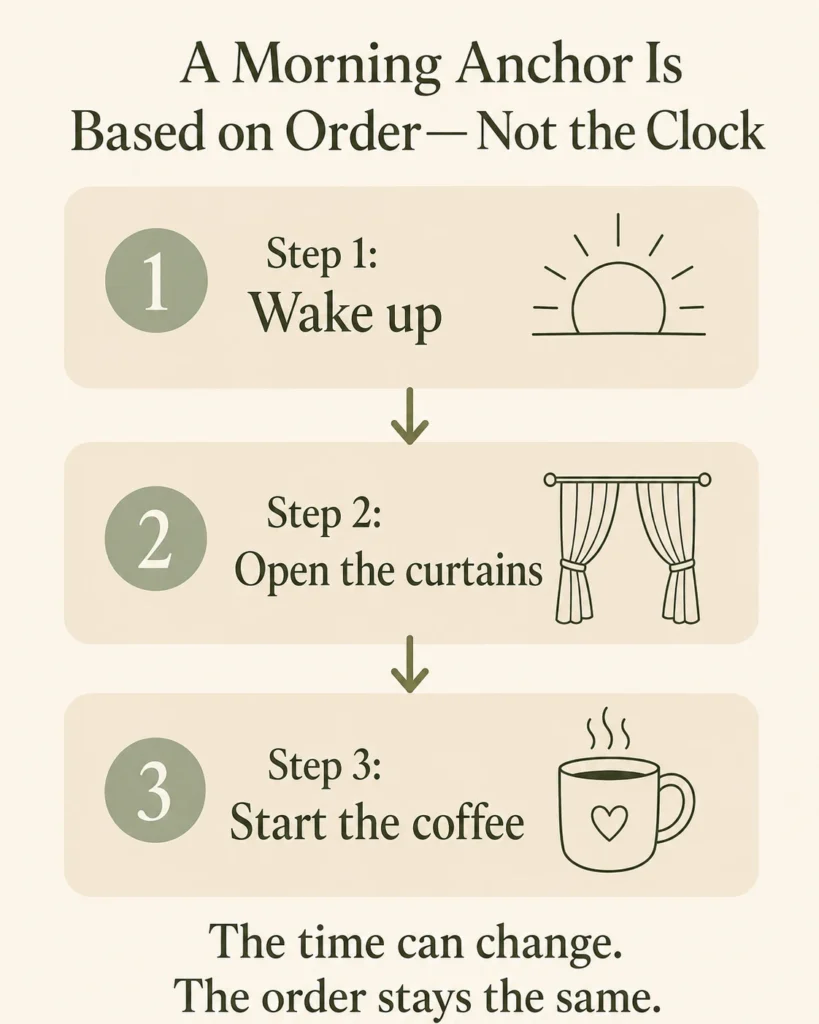
A morning anchor works differently because it is based on order, not the clock.
Instead of saying:
“I have to start coffee at 6:00.”
You say:
“When I wake up, I open the curtains and start the coffee.”
The time can change.
The order stays the same.
Maybe that happens at 6:00 on a normal morning.
Maybe it happens at 7:30 after a late night.
Maybe it happens even later because one of the kids was sick, you barely slept, or the morning started differently than you expected.
The anchor still counts.
That is what makes it feel so much more realistic.
You are not trying to force every morning into the same schedule. You are simply giving yourself one familiar sequence to return to.
When I wake up, I do this first.
That small sense of order can make a big difference.
Your brain does not have to immediately decide what to do, what time it is, or whether you are already behind. It already knows the first step.
Then the rest of the morning can unfold based on what your family actually needs that day.
Some mornings may move quickly.
Other mornings may be slower.
The kids may wake up earlier than expected.
Breakfast may take longer.
You may have an appointment, therapy, school preparation, or nowhere you need to be at all.
The details can change without taking away the steadiness of the anchor.
That is how you create consistency without making your mornings feel rigid.
Consistency does not have to mean doing everything at the exact same time every day.
Sometimes, consistency simply means returning to the same small starting point, no matter what time the day begins.
Choose One Action You Already Naturally Do
When you are choosing a morning anchor, try not to create an entirely new lifestyle for yourself.
You do not need to suddenly become someone who wakes up before sunrise, journals for thirty minutes, exercises, makes a full breakfast, and finishes the laundry before anyone else is awake.
Start with something that already happens most mornings.
That makes the anchor feel natural instead of forced.
Ask yourself:
- What is the first thing I usually do after getting out of bed?
- What action makes the house feel more awake?
- What helps me feel less scattered?
- What small task gives me an easy win?
- What makes the rest of the morning easier?
Your answers can help you find the right anchor for your real life.
If you always make coffee, let making coffee become your anchor.
You might start the coffee, open the curtains, and give yourself a quiet minute while it brews.
If morning clutter immediately makes you feel stressed, choose one counter to clear.
You do not need to clean the entire kitchen. Clearing one main surface may be enough to help the room feel calmer and give you a better place to begin.
If getting dressed changes your mood and helps you feel more awake, make that your anchor.
You do not need a full outfit, makeup, and styled hair. Simply changing out of pajamas may help your brain recognize that the day has started.
If laundry piles create pressure throughout the day, start or switch one load in the morning.
That one action allows the laundry to keep moving while you handle breakfast, the kids, appointments, or whatever else the day brings.
The best morning anchor is not the most impressive one.
It is not the one that looks best in a social media routine.
It is the one you will realistically repeat—even after a difficult night, on a low-energy morning, or when the day does not begin according to plan.
Simple and repeatable will support you far more than complicated and perfect.
Keep Your Morning Anchor Small
A morning anchor should be simple enough to complete even on a hard day.
That matters because the goal is not to create another large routine hiding behind a smaller name.
A morning anchor is not a 12-step checklist.
It is not an hour-long cleaning session.
It is not a full workout, an entire self-care routine, or finishing every household task before breakfast.
It should only take a few minutes.
That is what makes it realistic.
You could open the curtains and make the bed.
You could start the coffee and unload five dishes while it brews.
You could get dressed and do a simple skincare routine.
You could start the washer and clear the bathroom counter.
You could drink a glass of water and look at the calendar.
That is enough.
The anchor does not need to solve the whole morning.
It only needs to help you begin.
Keeping it small also makes it easier to repeat when you are tired, running behind, caring for a sick child, or starting the day with very little energy.
You may decide to do more once the anchor is finished, but the extra tasks are optional.
They are not part of what makes the morning successful.
Small is what makes the anchor repeatable.
And repeatable is what slowly turns one simple action into a steady rhythm you can trust.
Build the Rest of the Morning Around the Anchor
This is the same idea behind my back-to-front home reset: one clear starting point can keep me from bouncing between tasks and leaving everything half-finished.
Once your morning anchor is complete, you can decide what comes next based on what that particular day actually needs.
Some mornings may include making breakfast and helping everyone get ready.
Some may involve school preparation, therapy appointments, errands, work, cleaning, or getting out the door quickly.
Other mornings may be slower.
You may stay home, move at an easier pace, and let the day begin without rushing.
The anchor stays steady, but everything after it can remain flexible.
That is what makes this approach feel so much more realistic than a rigid routine.
You are not trying to force every morning to follow the same exact plan.
You are simply giving yourself one dependable place to begin.
Once that first action is complete, you can look at the day in front of you and respond to what matters most.
Maybe the next step is breakfast.
Maybe it is packing a bag for therapy.
Maybe it is starting schoolwork, answering an email, or sitting down for a few quiet minutes before the house gets busy.
The rest of the morning does not have to happen in the same order every day.
That flexibility keeps one unexpected change from making the entire morning feel ruined.
If an appointment gets moved, a child wakes up early, or breakfast takes longer than expected, you have not failed the routine.
You still completed the one small action that helps you feel grounded.
You still had a steady beginning.
And sometimes, that is all you need to keep the rest of the day from feeling completely scattered.
Create a Full-Energy and Low-Energy Version
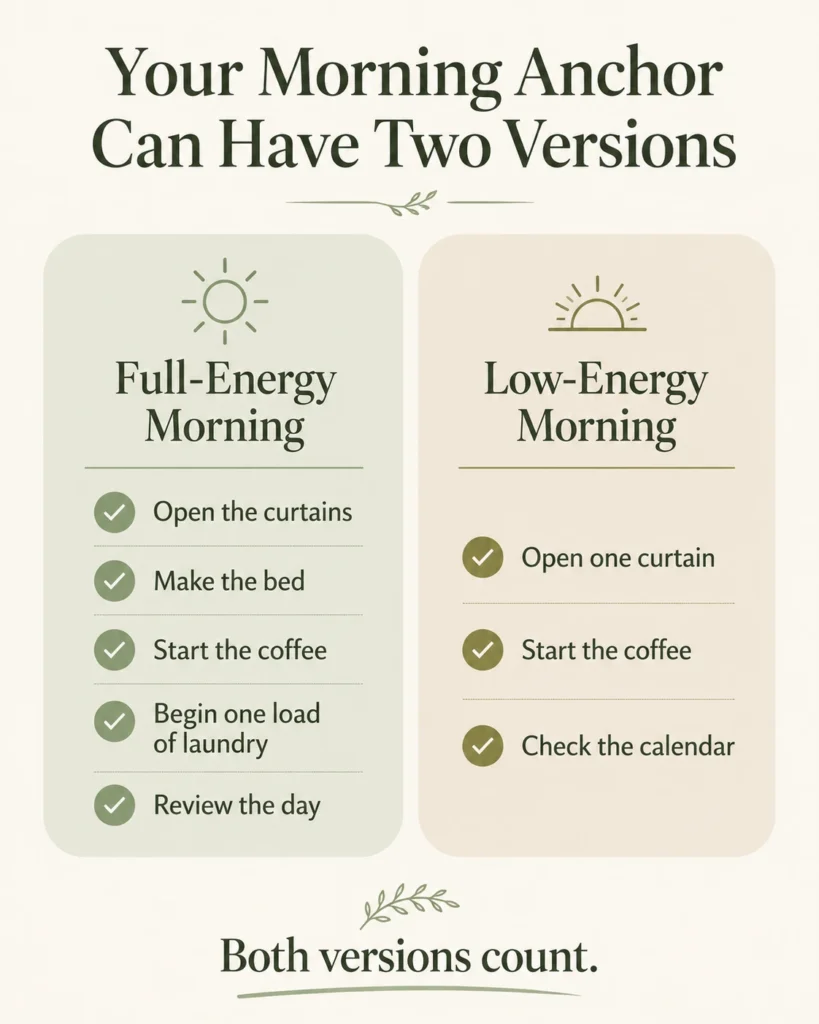
One of the easiest ways to make a morning anchor actually last is to give it two versions.
A full-energy version for the mornings when you slept well and feel ready to move.
And a low-energy version for the mornings when you are tired, overwhelmed, sick, or simply doing your best to get started.
Both versions are part of the same rhythm.
Full-Energy Morning Anchor
On a morning when you have more energy, your anchor might look like this:
- open the curtains
- make the bed
- start the coffee
- begin one load of laundry
- review the day
This version gives you a little more structure and can help the whole morning feel smoother.
But it is still simple.
It is not meant to become a long list of everything you need to accomplish before the day can begin.
Low-Energy Morning Anchor
On a harder morning, your anchor might look like this:
- open one curtain
- start the coffee
- check the calendar
That still counts.
You do not need to complete the full version for the morning to be successful.
The low-energy version helps you stay connected to the rhythm during difficult nights, sickness, stressful seasons, or mornings when motivation is low.
Instead of abandoning the routine completely, you simply make it smaller.
That can be the difference between feeling like you failed and feeling like you still showed up for yourself in a realistic way.
The goal is not to perform the morning perfectly.
The goal is to keep returning to the same steady beginning, even when the version changes.
Some days, you may have the energy to do more.
Other days, the smallest version may be all you can manage.
Both are valid.
Both support the rhythm.
And both help you begin the day with a little more intention and a lot less pressure.
Why Morning Anchors Help My Easily Distracted Brain
Large routines can feel overwhelming because they require so many decisions before the day has even really started.
You wake up and immediately begin asking yourself:
What should I do first?
Should I clean?
Should I get dressed?
Should I start breakfast?
Should I answer messages?
Should I begin the laundry?
When your brain is already trying to process several tasks at once, even a simple morning can start to feel heavy.
This is part of the invisible pressure so many moms carry throughout the day. I talk more about it in my post about the mental load of motherhood and why even small decisions can begin to feel exhausting.
Then there are all the transitions.
Going from getting dressed to making breakfast.
From breakfast to laundry.
From laundry to checking the calendar.
From the calendar to helping the kids get ready.
Each transition requires your brain to stop one thing, remember the next thing, and shift your attention again.
That can make a long routine feel exhausting before you have even finished it.
A morning anchor reduces some of that pressure.
You do not have to plan the entire morning the moment you wake up.
You only need to know the first step.
The anchor answers that first question for you.
When I wake up, I start the coffee.
When I get out of bed, I open the curtains.
When the day begins, I start one load of laundry.
Once that action is complete, I can decide what comes next based on what the morning actually needs.
That clear starting point helps reduce decision fatigue without making the whole day feel controlled.
Cleveland Clinic explains how decision fatigue can leave us mentally and emotionally depleted after making too many choices.
It gives your brain enough structure to begin, but it still leaves room for flexibility.
You are not trapped inside a strict schedule.
You are not trying to complete a long checklist in the perfect order.
You simply have one dependable action that helps you move from sleeping into starting the day.
For an easily distracted brain, that balance can feel especially helpful.
There is enough structure to keep you from feeling completely scattered, but enough freedom to adjust when the kids wake up early, plans change, or your energy looks different than expected.
The anchor does not tell you how the whole morning has to go.
It simply gives you a clear place to begin.
What to Do When You Miss a Morning
Missing one morning does not mean the system failed.
It does not mean you are inconsistent.
It does not mean you need to start over with a stricter plan.
Sometimes the night before was difficult.
Sometimes a child wakes up early.
Sometimes you are sick, exhausted, rushed, or simply not feeling like yourself.
That is real life.
You do not need to wait until Monday to try again.
You do not need to wait for the beginning of a new month.
You do not need to add more rules to make up for the morning you missed.
Just return to the anchor the next morning.
That is the beauty of building a rhythm instead of following a rigid routine.
A rhythm is something you return to, not something you perform perfectly.
There is no punishment for missing a day.
There is no need to catch up.
You simply begin again with the same small action.
Open the curtains.
Start the coffee.
Drink the water.
Check the calendar.
Whatever your anchor is, let it welcome you back without guilt.
Consistency does not mean never missing a morning.
It means knowing where to return when life interrupts the plan.
That is how grace becomes part of the system.
You are not trying to prove that you can follow a routine perfectly.
You are creating a steady starting point that will still be there when you are ready to come back.
Simple Morning Anchor Ideas for Busy Moms
Your morning anchor does not need to look like anyone else’s.
It should support the part of your morning that usually feels the most scattered.
Here are a few simple options to help you choose one that fits your life.
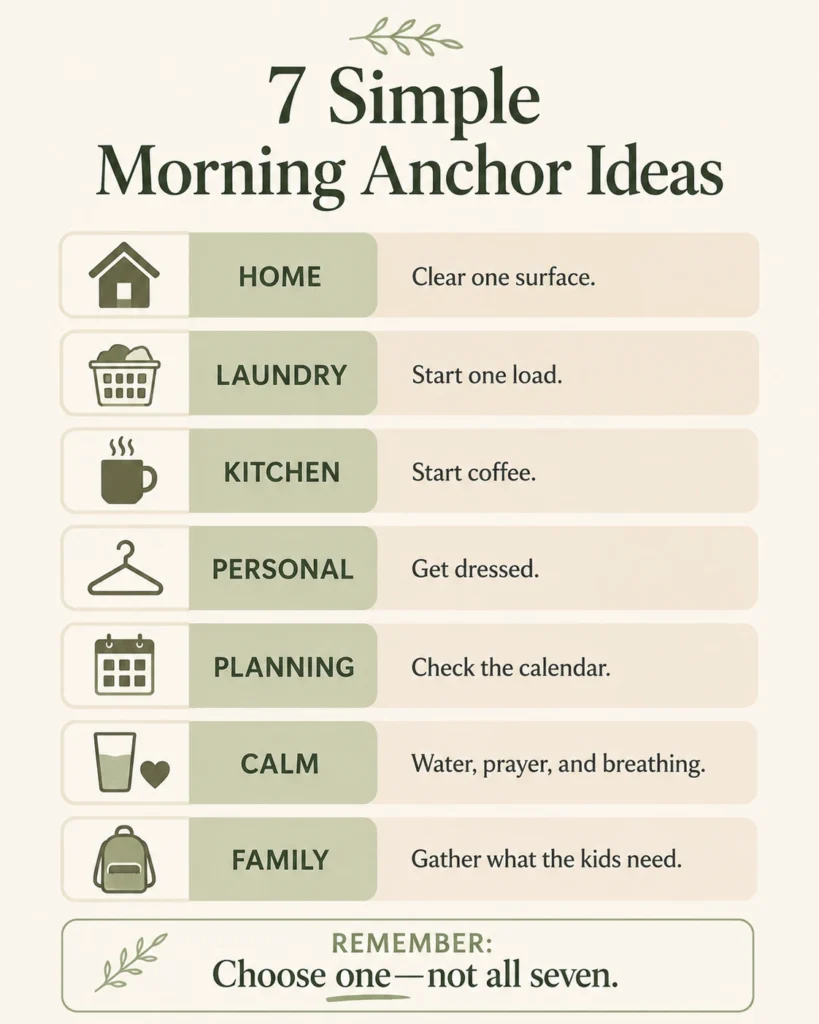
Home Anchor
Open the curtains and clear one main surface.
This could be the kitchen counter, dining table, or bathroom vanity.
You are not cleaning the whole room. You are simply creating one calm, clear space to begin the day.
Laundry Anchor
Start or switch one load of laundry.
This works well if laundry tends to pile up and stay on your mind throughout the day.
Getting one load moving early gives you a small win without requiring you to finish all of the laundry at once.
Kitchen Anchor
Start the coffee and unload the dishwasher.
You could also unload only part of it while the coffee brews.
This helps the kitchen feel ready for breakfast, dishes, and whatever the rest of the day brings.
Personal Anchor
Get dressed before checking social media.
For some moms, changing out of pajamas helps signal that the day has started and makes it easier to move into the next task.
It does not need to mean a full outfit, makeup, or styled hair.
Just getting dressed can be enough.
Planning Anchor
Look at the calendar and choose the day’s top priority.
Instead of waking up and trying to remember everything at once, decide what matters most for that day.
There may be many things you would like to accomplish, but choosing one priority can help your mind feel less crowded.
Calm Anchor
Drink a glass of water, take three deep breaths, and say a short prayer.
This can be a gentle way to begin when you need calm more than productivity.
It gives you a moment to slow down before the needs of the day begin pulling at your attention.
Family Anchor
Prepare breakfast and gather what the children need for the day.
This could include water bottles, school items, therapy bags, clothes, or anything else that helps the morning run more smoothly.
The goal is not to prepare the entire day.
It is simply to complete the first helpful step for your family.
You do not need to choose all of these.
That would quickly turn one small anchor into another overwhelming morning checklist.
Choose the one action that would make the biggest difference in your mornings right now.
Let that be your starting point.
Once it feels natural, you can build around it slowly—but one steady anchor is already enough.
Your Morning Does Not Need to Look the Same Every Day
Consistency does not mean every morning has to look exactly the same.
That is one of the biggest shifts that makes a morning anchor feel realistic.
Some days, the kids may wake up earlier than expected.
Other days, everyone may sleep a little longer.
Appointments may change.
Therapy may start early.
Breakfast may take more time.
Your energy may feel completely different from one morning to the next.
Some mornings may feel productive and steady.
You may get dressed, start the laundry, clear the kitchen, and feel ready for the day.
Other mornings may move more slowly.
You may sit with your coffee longer, help a child through a hard start, or simply focus on getting everyone fed.
Neither kind of morning is wrong.
The anchor creates familiarity inside all of that flexibility.
Even when the schedule changes, you still have one small action that helps you feel grounded.
You may not know exactly what the whole morning will look like, but you know where to begin.
That keeps a different morning from becoming a directionless one.
Your morning can change without feeling like it has fallen apart.
You can adjust to what your family needs while still returning to the same steady starting point.
That is what makes a morning anchor supportive.
It creates consistency without expecting real life to be predictable.
Start With One Anchor This Week
You do not need to redesign your entire morning today.
Start with one small anchor and give it time to become familiar.
1. Choose One Small Action You Already Do Most Mornings
Pick something that already fits naturally into your life.
Maybe you start the coffee, open the curtains, get dressed, check the calendar, or begin one load of laundry.
The easier it feels to begin, the more likely you are to repeat it.
2. Make It the First Intentional Step of Your Day
Your anchor should be the first thing you choose to do on purpose.
It does not have to be the very first thing that happens.
A child may need you.
The dog may need to go outside.
Someone may already be asking for breakfast.
But when you have a moment to choose your next step, return to the anchor.
3. Keep It Simple Enough for a Low-Energy Morning
Ask yourself whether you could still complete the anchor after a difficult night or on a morning when you feel tired and unmotivated.
If the answer is no, make it smaller.
You can always do more when you have the energy.
The anchor itself should remain easy.
4. Repeat It for One Week Without Adding More Tasks
Try not to turn the anchor into a full routine immediately.
Do not add five new habits because the first one felt good for two days.
Repeat the same small action for one week and let it become familiar.
The goal is to build trust with the rhythm before making it bigger.
5. Notice Whether Your Morning Feels Less Scattered
At the end of the week, think about how the anchor affected your mornings.
Did it help you begin without overthinking?
Did you feel a little more grounded?
Did it make the next step easier to see?
The change may feel small, and that is okay.
A morning anchor is not meant to transform your entire life overnight.
It is simply meant to give you one steady place to begin.
Let that one action become natural before you build anything else around it.
You do not need five new habits.
You need one small rhythm you can realistically return to.

Frequently Asked Questions
What is a morning anchor?
A morning anchor is one small, dependable action that helps you begin your day. It is not a complete routine or a long checklist. It is simply one familiar action that gives you a clear place to start.
How is a morning anchor different from a morning routine?
A traditional morning routine often includes several tasks completed at specific times. A morning anchor focuses on one small action that stays familiar even when the time, schedule, or rest of the morning changes.
How long should a morning anchor take?
A morning anchor should take only a few minutes. It should be simple enough to complete after a difficult night, during a stressful season, or on a low-energy morning.
What are some easy morning anchor ideas for moms?
Starting coffee, opening the curtains, getting dressed, drinking water, checking the calendar, or beginning one load of laundry can all work as morning anchors. Choose only one action that naturally fits your life.
What happens if I miss my morning anchor?
Nothing needs to be restarted or made up. Simply return to your anchor the next morning. A rhythm is something you return to, not something you perform perfectly.
You Don’t Need a Perfect Morning Routine
Your morning does not need to begin at 5:00 a.m. to be peaceful.
You do not need a perfectly timed checklist, an hour of quiet before the kids wake up, or a long list of habits completed before breakfast.
You do not need to control every part of the morning.
Real life will still happen.
Kids will wake up early.
Sleep will be interrupted.
Appointments will change.
Some mornings will feel steady, and others will feel messy before you have even had your coffee.
That does not mean the whole day is ruined.
You only need one familiar place to begin.
One small action that helps your brain and body recognize that the day has started.
One steady step you can return to even when the rest of the morning looks different than you planned.
You do not need a rigid routine that falls apart the moment real life happens. You need one small morning anchor you can return to again and again.
Let it be simple.
Let it fit your family.
Let it support your real life instead of becoming another standard you feel pressured to meet.
Because a calmer morning does not begin with doing everything.
It begins with knowing what to do first.
Here’s your reminder that simple is enough.
Start with one small anchor, build from there, and create a morning rhythm that works with your life—not against it.
Save this idea for a morning when a full routine feels like too much.